A load cell is a sensor that turns force or weight into an electrical signal you can measure. You will find this device at the heart of almost every weighing system, from a bench scale in a lab to a hopper scale in a processing plant. Its main job is to measure force, and that job matters in many industries. Accurate readings protect product quality, support fair trade, and keep automated processes running smoothly. If you have ever wondered what is a load cell and where it fits, the answer starts with this simple idea: load cells turn physical push or pull into data your instruments can read.
Key Takeaways
What Is a Load Cell?
Definition and Core Purpose
A load cell is a force transducer. It is an electro-mechanical sensor that turns tension, compression, pressure, or torque into an electrical signal that matches the force applied. Think of it as a translator. It takes a physical push or pull and changes it into a voltage your instruments can read.
Engineers often call this device a type of transducer because it changes one form of energy into another. The input is mechanical force. The output is an electrical signal. That conversion is at the heart of how a load cell is designed and how it works.
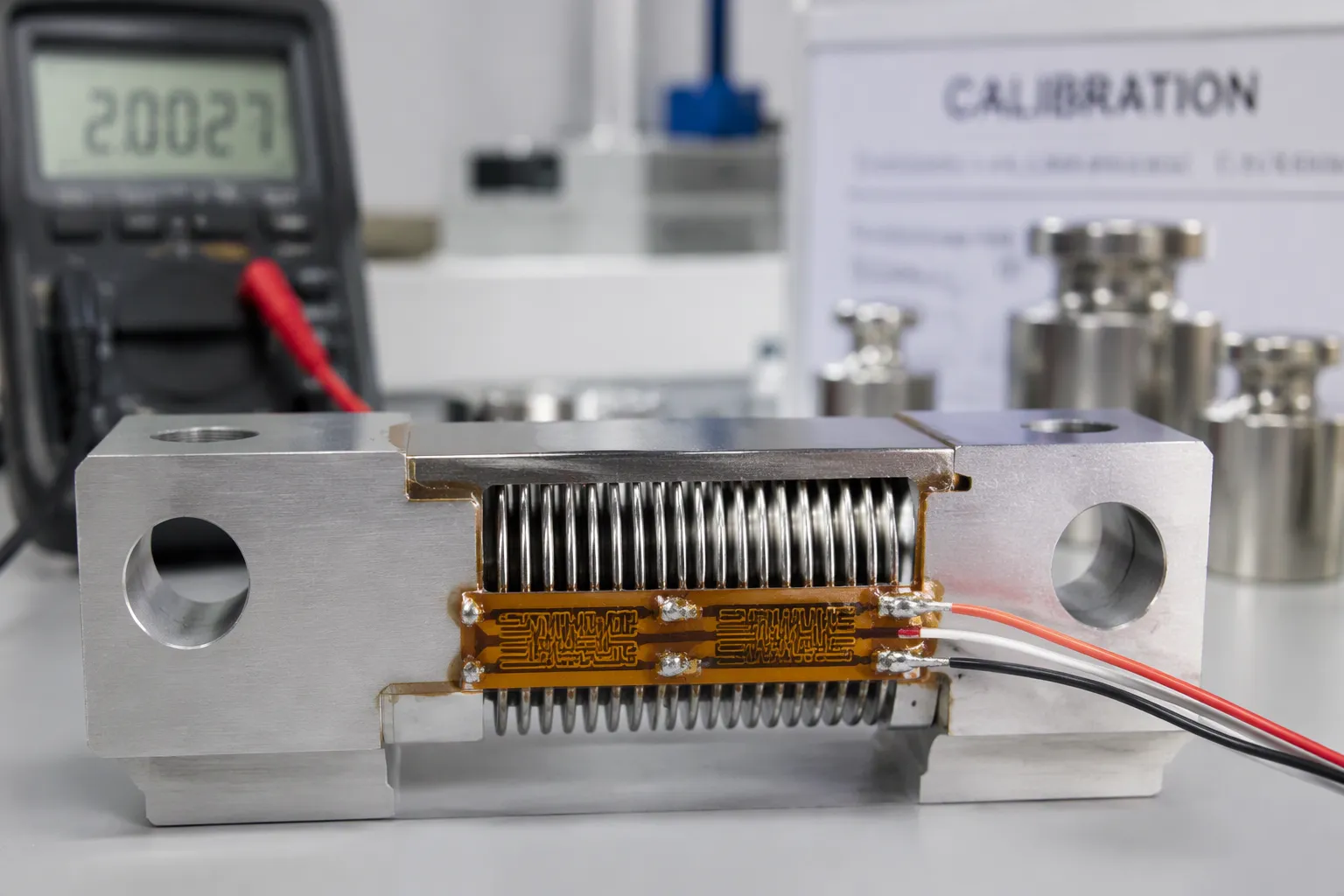
A typical unit has a spring element, usually made of steel or aluminum. Strain gauges are bonded to this element. When a load bends or compresses the metal, the gauges stretch or squeeze along with it. The metal body protects the gauges and goes back to its original shape once you remove the load.
The core purpose is simple: measure force or weight with repeatable accuracy. A load cell sensor gives you a reliable number instead of a guess. That is why these devices show up in scales, batching systems, and testing machines around the world.
Force, Weight, and Signal Output
People often use the words force and weight as if they mean the same thing. In practice, they describe different measurements. Force is any push or pull on an object. Weight is the force gravity exerts on a mass. A load sensor can measure force directly, and you can turn that reading into weight when gravity is known and constant.
This distinction matters when you pick a device. Some systems measure force in newtons. Others report weight in kilograms or pounds. The sensor itself responds to mechanical force either way. Your indicator or software handles the conversion.
Most analog load cells output a millivolt-per-volt signal, written as mV/V. The output is small, so it needs an amplifier or indicator to become a usable reading. This analog signal matches the load applied. Double the load, and the output roughly doubles within the rated range.
When you ask what are load cells and how they report data, the answer comes down to this signal chain. The sensor makes a tiny voltage. The electronics scale it up. The display shows a number you can trust. Understanding this flow helps you troubleshoot problems and choose the right load cells for your application.
How Does a Load Cell Work?
Strain Gauges and the Wheatstone Bridge
The answer to how a load cell works starts with a thin metal foil pattern called a strain gauge. You attach these gauges to the spring element, the metal body that bends under load. When you apply force, the element bends a little. The gauge stretches or squeezes along with it. A stretched gauge gets longer and thinner, so its electrical resistance goes up. A squeezed gauge gets shorter and wider, so its resistance goes down. This change is very small, but it is the starting point of every reading.
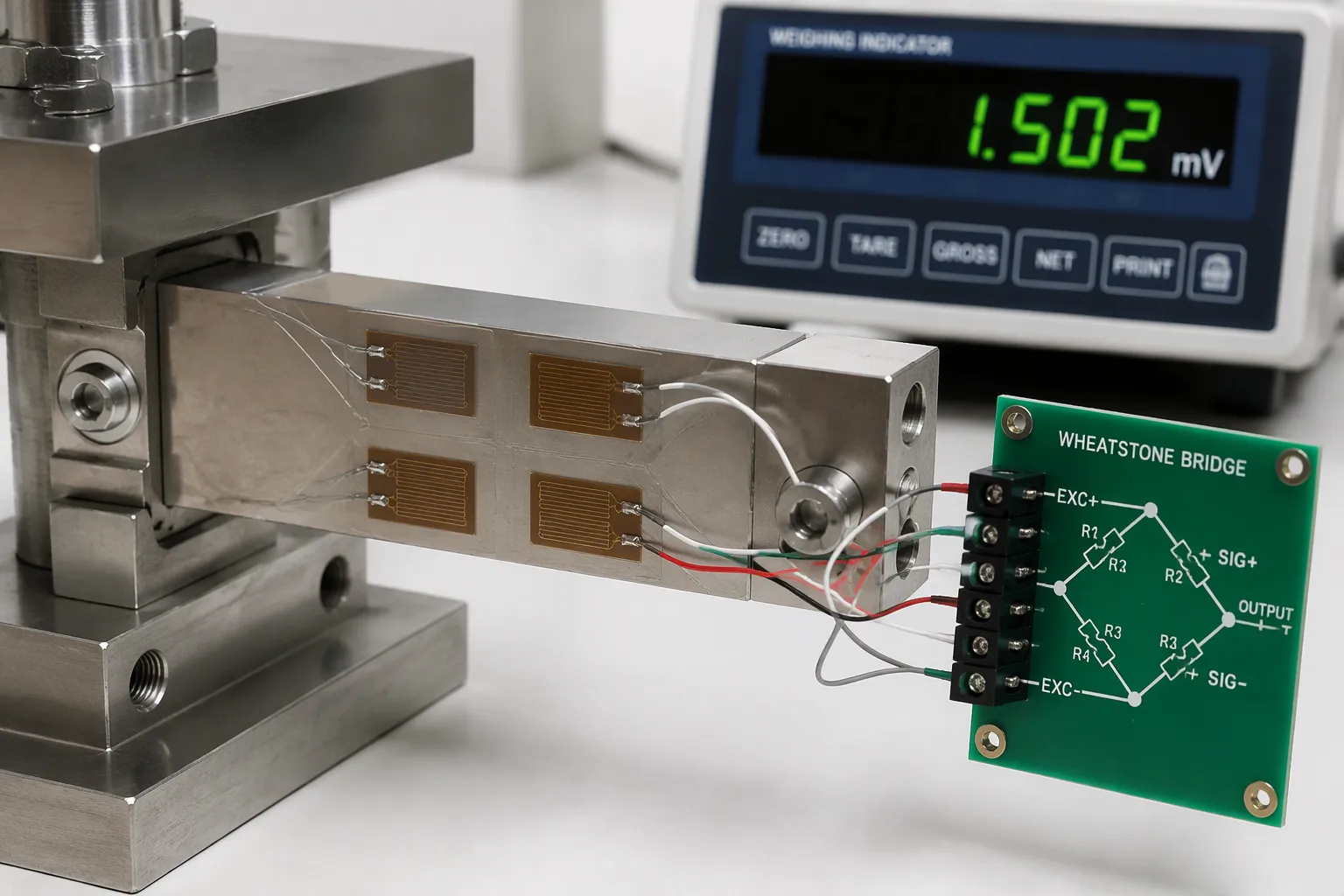
A change in just one gauge is too small to measure reliably by itself. The wheatstone bridge circuit fixes that problem. This circuit puts four resistive arms in a diamond pattern and feeds them a steady input voltage. When the arms stay balanced, the output stays near zero. When the gauges change resistance, the bridge loses balance and makes a small voltage difference. That difference matches the load applied. The wheatstone bridge circuit also cancels common errors like temperature drift, which is why it shows up in nearly every strain gauge design.
Understanding the design and function of a load cell comes down to this pairing. The spring element carries the force. The gauges sense the strain. The bridge turns strain into a clean electrical signal. Together they make a precise force measurement system with few moving parts.
From Signal to Readout
The bridge output is a millivolt-per-volt signal, written as mV/V. This signal is small, often just a few millivolts at full capacity. It travels down a cable to an amplifier or weighing indicator. The amplifier boosts the signal and turns it into a digital value. The indicator then shows a weight, logs the reading, or sends it to a control system. This chain explains how do load cells work in practice: physical force becomes voltage, voltage becomes data, and data becomes a decision.
Digital load cells take this process further. They add a built-in analog-to-digital converter with 24-bit resolution right inside the housing. The conversion happens at the sensor, so weak analog signals travel a very short distance. Noise and interference have less chance to spoil the reading. The digital output then travels over a fieldbus such as CAN BUS, MODBUS-RTU, or PROFINET. Digital models also support self-diagnosis and real-time monitoring, so you can spot a fault before it stops production.
This is the full picture of how a load cell works. Strain creates resistance change. The bridge creates voltage. The electronics create a usable number. Each stage builds on the last, and each stage rewards careful installation and clean wiring.
Load Cell Types by Principle
Strain Gauge, Hydraulic, Pneumatic, Capacitive
You can sort the different types of load cells by the physical principle each one uses. Strain gauge load cells are the most common pick. A bonded foil gauge stretches with a metal element and changes resistance. These load cells based on strain gauges give high accuracy and a fast response. Most industrial scales depend on them.
Hydraulic load cells use a piston and a fluid-filled chamber. Applied force raises the fluid pressure, and a gauge reads that pressure. These units are sturdy and handle very high capacities. They work well for heavy machinery and rough outdoor sites where electronics have trouble.
A pneumatic load cell balances force against air pressure. To understand how a pneumatic load cell works, picture a diaphragm that bends under load and vents air through a nozzle. The back pressure follows the applied force. These devices work well in hazardous areas because they make no electrical spark.
Capacitive load cells measure the gap between two plates. A small load narrows that gap and changes capacitance. These sensors pick up very light forces with great sensitivity. You will find them in laboratory and low-force measurement work.
Matching Principle to Environment
Each principle fits a distinct setting, and no single option wins everywhere. Choose strain gauge load cells when you need accuracy, fast sampling, and easy hookup with indicators and fieldbuses. Pick hydraulic designs for high capacity and harsh conditions. Select pneumatic units for explosive or flammable environments. Reach for capacitive sensors when the force is small and precision matters most.
Start with your environment and your accuracy target. Then match the principle to that pair. This approach turns a long list of types of load cells into a clear shortlist. A strain gauge load cell covers most general weighing tasks. Specialty principles cover the edges. Together they give you a tool for nearly any force measurement job.
Load Cell Types by Design
Single Point, Bending Beam, Compression, Tension
The shape of a load cell decides where it can go. A single point load cell takes a load that sits off to one side and still gives a true reading. You will see this design in bench scales, counting scales, and small platform scales. A bending beam load cell bends at one end when a load is applied. It works well for belt scales, hopper scales, and tank weighing.
A compression load cell takes a push from above. It handles high capacities and fits truck scales and silo weighing. A tension load cell measures a pulling force. You will find it in crane scales, hanging hoppers, and cable tension monitoring. These four designs cover most weighing jobs. Each one fits a certain mounting style and load direction.
Specialty Designs and Webowt Modules
Webowt makes high-precision load cells and weighing modules for tough settings. The bodies are made of stainless steel or aluminum. IP68 welded sealing keeps out dust and water. Special surface treatments like phosphating, nickel plating, and electrochemical polishing add long-term protection against rust.
The analog series includes the WB1020, WB1260, WB1260A, WB1260B, WB1260BS, WB701, and WB702. Capacities run from 3g to 500kg. Digital models add CAN BUS output, 24-bit resolution, 3,000e C6-class calibration, and sampling up to 1200Hz. These modules work with PROFIBUS-DP, PROFINET, EtherNet/IP, CC-LINK, EtherCAT, MODBUS-RTU, and MODBUS-TCP.
Feature | Analog Series | Digital Models |
Output | mV/V | CAN BUS |
Resolution | — | 24-bit |
Calibration | Standard | 3,000e C6 class |
Sampling | — | Up to 1200Hz |
You can compare different types of load cells by design and choose the shape your mounting allows. The right pick depends on load direction, capacity, and environment.
Key Applications and Selection
Industries and Use Cases
Load cells measure weight in many different industries. Industrial weighing covers the basics: bench scales, floor scales, and tank weighing. Packaging lines use them to fill bags and bottles to a target weight. Belt scales and hopper scales track material flow on conveyors and in silos. Logistics sorting systems weigh parcels at speed and send them on their way without a pause. You will also find these sensors in pharmaceutical production, food and beverage processing, fine chemicals, and lithium battery and new materials manufacturing.
Each setting asks something different from the sensor. A parcel sorter needs a fast response and a tough body. A pharmaceutical line needs tight load cell accuracy and clean, easy-to-sanitize surfaces. A hopper scale in a chemical plant needs protection from dust and moisture. Webowt meets these needs with solutions for pharma audit tracking, clean weighing, and error-prevention systems. The brand holds global certifications including OIML, CE, PAC, and EAC, so you can match a unit to your compliance requirements.
Choosing the Right Load Cell
Choosing a load cell comes down to five factors. Start with accuracy: match the sensor to the tolerance your process allows. Next, check capacity so the rated range covers your heaviest load with some room to spare. Then review environmental protection, since the IP rating decides whether dust and washdown will shorten the unit's life. Look at installation space and load direction, because a single point design will not fit where a compression design belongs. Finally, confirm that it works with your existing wiring, indicator, and fieldbus.
No single type of load cells is best for every job. A design that shines in a clean lab may struggle on a wet factory floor. Use these factors as a checklist, and let your application set the priority order. Force measurement in a battery plant and force measurement on a truck scale pull the choice in different directions. Webowt offers analog and digital options across capacities from 3g to 500kg, so you can match the sensor to the job rather than the other way around.
A load cell changes force into an electrical signal. Strain gauges on a spring element do this job through a Wheatstone bridge. You have seen the main types by principle and by design, plus the industries that use them. The right load cell depends on your accuracy goal, your environment, and your installation space.
Use the selection factors as a practical checklist before you buy. Webowt offers analog and digital load cells in capacities from 3g to 500kg, so you can match the sensor to your job.
FAQ
What is the difference between an analog and a digital load cell?
An analog load cell sends out a small mV/V signal. You need an outside amplifier or indicator to read it. A digital model has a 24-bit converter built in and sends data over CAN BUS. That setup gives you self-diagnosis and real-time monitoring.
Which load cell works best for dynamic weighing?
Choose a model with a fast sampling rate and a strong body. Webowt digital modules sample up to 1200Hz and have IP68 welded sealing. That mix handles moving loads on sorting lines and filling machines without missing a reading.
How do I reduce signal interference on an analog setup?
Keep shielded cables away from power lines. Use a junction box when you run several sensors together. If interference keeps causing trouble, switch to digital CAN BUS transmission. The conversion happens inside the housing, so weak analog signals travel a very short distance.
What capacity range does Webowt offer?
Webowt analog load cells cover 3g to 500kg. The series includes the WB1020, WB1260, WB1260A, WB1260B, WB1260BS, WB701, and WB702. You can match a unit to light lab work or heavier industrial weighing with the same product family.
Do Webowt load cells meet global compliance standards?
Yes. Webowt holds OIML, CE, PAC, and EAC certifications. Digital models also support 3,000e C6-class calibration. You can match a unit to the compliance rules your market requires.