Picture this: you're in your kitchen, carefully measuring flour for a cake, or maybe you're in a warehouse, checking the weight of a package before shipping. You trust the number on the screen, but have you ever wondered how a scale knows exactly how much something weighs? The answer lies in a small but mighty part called a load cell. This sensor works like the scale's brain, turning physical force into a number you can read. The global load cell market, worth USD 2.14 billion in 2025, shows how vital these devices are. This post explains how load cells for scales work, their types, and how to pick the right one for your weighing needs.
Key Takeaways
A load cell changes weight into an electrical signal, working like the scale's brain.
Strain gauges and a Wheatstone bridge circuit work together to detect very small changes in resistance, which helps the scale give precise measurements.
Pick a load cell that can handle 20-50% more weight than your heaviest load. This extra room helps stop damage.
Pick a load cell that fits your surroundings. For wet or dusty areas, choose one with an IP68 rating.
Calibrate your scale every 3-6 months to keep it accurate and make it last longer.
What is a load cell?
Image Source: pexels
A load cell is a sensor that changes force into an electrical signal. Think of it as a translator: it takes the push or pull of a weight and turns it into a number your scale's screen can show. Every weighing device you use, from a small kitchen scale to a giant truck scale at a highway station, uses this same basic technology. The load cell is the heart of the system. It quietly does its job every time you weigh something.
The basic principle of force conversion
The process starts with a simple fact about materials: when you push or pull on something, it changes shape. A load cell uses this idea with a special metal part called a flexure. When you put an object on a scale, gravity pulls it down. This force presses on the flexure. The flexure bends very slightly, just enough to handle the weight but still spring back. This bending follows Hooke's Law, which says force equals a constant times the amount of bend. So the flexure bends in a direct way based on the weight. This gives a clear, repeatable link between force and movement.
Hooke's Law, written as F=kx, describes this straight-line link between force and bend. Load cells use this idea. By putting strain gauges on the flexure, the straight-line link between resistance and strain, plus the straight-line link between strain and force, gives the load cell a direct link between resistance and force. This makes measuring force simple and reliable.
The flexure is designed to stay in its elastic zone. That means it goes back to its original shape when you remove the weight. This stretchiness keeps the performance steady over many uses. That is important for accurate weighing in factories.
The role of strain gauges in measurement
Now comes the clever part. Small devices called strain gauges are glued to the flexure. These gauges have thin metal foil arranged in a zigzag pattern on a flexible backing. When the flexure bends, the strain gauges bend with it. Under tension, the foil stretches and gets longer. This makes its electrical resistance go up. Under compression, it shrinks and gets shorter. This makes resistance go down. The change in resistance matches the amount of strain, which matches the force applied.
The strain gauges are wired in a Wheatstone bridge circuit. This circuit measures tiny changes in resistance very well. A voltage flows through the bridge. When no weight is on the scale, the bridge is balanced and gives zero output. When you add a weight, the bridge becomes unbalanced. It sends out a small voltage that is proportional to the weight. Usually, this output is about 2 millivolts per volt of input at full capacity. Electronics then boost this small voltage, change it to a digital signal, and turn it into the weight you see on the screen.
This whole chain of events happens in a split second. Yet it gives the accuracy you expect from modern scales. Whether you are measuring ingredients for a recipe or checking shipment weights, the load cell's job of turning mechanical force into a precise electrical signal is the base of every weighing task. Knowing this process helps you see the engineering behind load cells for scales and why choosing a good load cell matters for reliable results.
How load cells work in scales
From deformation to electrical signal
When you put something on a scale, a set of steps starts inside the load cell. The weight pushes down on a metal part called a flexure. This part bends a little under the force. Strain gauges on the flexure bend with it. As they bend, their electrical resistance changes. This change goes into a Wheatstone bridge circuit. That circuit can spot even very small changes. The bridge turns these resistance changes into a small voltage signal. That voltage matches the amount of force applied. All of this happens in milliseconds, yet it gives you the steady force reading you rely on.
The Wheatstone bridge is worth a closer look. It uses four resistors set in a diamond shape. Strain gauges act as one or more of these resistors. With no weight on the scale, the bridge stays even and sends out zero voltage. When you add weight, the gauges bend and their resistance shifts. This unevenness creates a voltage difference across the bridge ends. The size and direction of this voltage match the applied force. This smart design lets the load cell turn tiny mechanical changes into a readable electrical signal.
Here is the full process from weight to signal:
Weight on the load cell pushes on the metal part, causing a small bend.
Strain gauges on the part measure this bend.
As the part bends, the strain gauges bend too, changing their electrical resistance.
The resistance change is picked up and turned into an electrical signal using a Wheatstone bridge circuit.
The electrical signal, which matches the bend, is made stronger and changed into a digital signal by signal-processing electronics.
The digital signal is used to figure out weight based on the load cell's specs and calibration.
The final weight reading is shown as a digital display or sent to a computer or control system.
Signal processing and display
The raw signal from a load cell is very small. A typical output might be only 10 to 40 millivolts at full load. That signal is too weak for standard tools to read correctly. An amplifier steps in to boost the signal to a useful level. Instead of sending weak millivolt signals over long cables, an amplified load cell turns the output into strong, high-level analog signals like 0–10 VDC or 4–20 mA. These signals resist noise in electrically rough settings, work well with standard A/D converters, and perform reliably over long cable runs. Amplifiers can be built into the load cell or placed outside.
After boosting, the signal goes to an analog-to-digital converter. This part changes the continuous analog voltage into separate digital values. A digital scale then processes these values using calibration data saved in its memory. The processor uses the calibration curve to turn the raw digital number into a weight reading. Finally, the display shows the result. In factories, the signal may also go to a PLC or computer for recording and analysis.
Calibration keeps this whole system honest. Without proper calibration, even the best load cell drifts over time. Things like temperature changes, humidity, and vibration all affect performance. Regular calibration fixes these errors. The process involves using known weights, checking the output readings, and adjusting the system to match the expected values. Two-point calibration adjusts at zero and one other load value. Multipoint calibration adjusts at several points across the full range to fix unevenness and get better accuracy.
Watch for signs that your scale needs recalibration. Visible damage like cracks or rust affects measurement accuracy. Odd behavior like frozen readings or slow response points to misalignment. A shift in the zero point hurts all later measurements. Heavy use in rough conditions speeds up drift, so regular calibration is a must. Webowt's analog load cells are built for high precision and stability in this conversion process. Their stainless steel build and IP68-rated sealing help keep performance steady, cutting down on how often you need to recalibrate. When you understand how load cells for scales work, you can take better care of them and trust what they show.
Types of load cells for scales
Not all load cells work the same way. Different designs fit different jobs. Knowing your options helps you pick the right one.
Strain gauge load cells: the industry standard
Strain gauge load cells are the type you will see most often. They give high accuracy, a wide range of weights, and strong build quality. You will find them in most factory scales and store scales. Their design is simple. A metal flexure bends under weight, and strain gauges on the flexure change resistance. Electronics turn this change into an electrical signal for the display.
Several subtypes of strain gauge load cells exist for different uses.
Load Cell Style | Description | Typical Applications |
Single-Point | Aluminum; capacities 1–1,000 kg | Bench scales |
Single-Ended Beam | Secured at one end; 0.5–10 tons | Filling/packaging machines |
Double-Ended Beam | Secured at both ends; up to 100 tons | Tank scales, vessel retrofits |
Compression Canister | Stainless steel; high precision | Truck and railcar weighing |
S-Beam | S-shaped; measures tension loads | Tank weighing, hoppers |
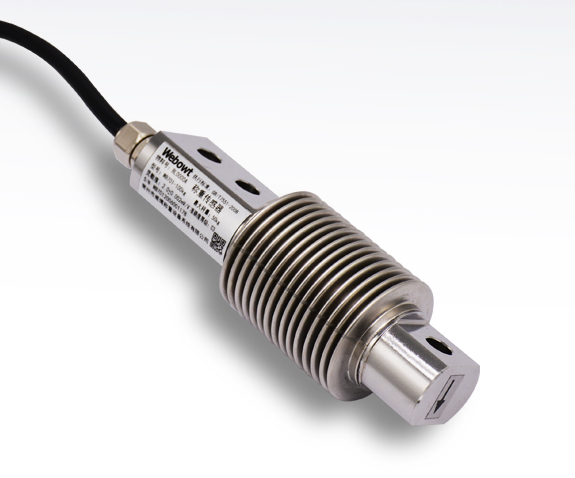
Webowt offers both analog and digital strain gauge load cells. Digital models use CAN BUS technology for steady data flow and self-checks. This gives you live tracking and simpler calibration. Whether you need a basic analog load cell for a digital scale or a digital model for a complex system, Webowt provides dependable performance.
Hydraulic, pneumatic, and capacitive alternatives
While strain gauge types lead the market, other technologies serve special needs. Hydraulic load cells use a fluid-filled chamber with a piston. Force on the piston creates pressure in the fluid. A gauge reads this pressure to find the weight. These cells handle very heavy loads in harsh conditions. You will find them in heavy lifting gear and construction load monitoring. They work well in dangerous areas because they have no electrical parts. However, they are larger and need tight sealing.
Pneumatic load cells work with air pressure. A load presses on a diaphragm, changing the air pressure inside. The system balances the pressure, and a gauge turns the reading into a weight. These cells are perfect for explosive areas where sparks are a risk. You will see them in food plants and chemical plants. The downside is slower response and lower accuracy.
Capacitive load cells measure changes in capacitance between two plates. As force changes the gap between the plates, the capacitance shifts. This gives high sensitivity and accuracy for force measurement. You will find them in ultra-precise factory scales, lab balances, and automatic checkweighers. However, they react to temperature shifts and moisture. Regular calibration is needed to keep measurements correct.
Knowing these options helps you match the right technology to your task. For most everyday weighing, strain gauge load cells give the best mix of cost, accuracy, and dependability.
Choosing load cells for scales
Picking the right load cell for your scale is more important than you think. A bad choice can cause poor accuracy, many breakdowns, or even safety issues. Three things guide your choice: capacity, accuracy, and environment. You also need to match the load cell type to your specific job. Let us go through each factor.
Key factors: capacity, accuracy, and environment
Start with capacity. You need a load cell that can handle more than your heaviest expected weight. A common mistake is choosing a capacity that equals the maximum load exactly. For a safe calculation, you must add up the maximum live load (the weight you want to measure) and the dead load (the weight of the scale platform or tank). Then add a safety buffer of 20-50% to protect the inner strain gauge from sudden shock loads. For example, if you have a 1000kg tank with a 200kg hopper, and you multiply by a 1.3 dynamic factor and a 1.5 safety factor, you get 2,340kg. That means you should pick a 2,500kg or 3,000kg load cell. Choosing a capacity too small risks overload and serious failure. Choosing one too large loses precision, especially in the lower measurement range.
Next comes accuracy. OIML R60 defines accuracy classes like C3 (up to 3,000 verification intervals) and C6 (up to 6,000 intervals). Higher classes mean tighter error limits and better temperature performance. For most industrial weighing, a C3 load cell works well. For high-precision dosing or legal-for-trade uses, you need C4 or higher. A C6 class gives the high accuracy needed for dynamic checkweighing and food packaging. Factors like nonlinearity, hysteresis, and nonrepeatability all affect the final reading.
Environment plays a big role. Temperature changes cause materials to expand and shrink. A 10°C rise in room temperature without compensation could cause output drift up to ±0.05% of full scale. Moisture damages strain gauges and rusts internal parts. Dust and chemical exposure also shorten a load cell's life. Webowt's load cells for scales have IP68-rated welded sealing and stainless steel build. This makes them good for harsh environments with dust, water, and chemicals. Advanced surface treatments like phosphating and nickel plating add extra protection.
Matching load cell type to your application
Different load cell technologies fit different jobs. Strain gauge load cells are the best choice for general industrial weighing. They are very durable, stiff, and have high resonance. Hydraulic load cells work well in dangerous areas because they have no electrical parts. They need no power, making them ideal for remote places. Pneumatic load cells suit clean environments where you need precise mechanical balance without oil leaks.
You also choose between analog and digital load cells. Analog cells send out a weak millivolt signal that needs outside amplification. They are cheap and reliable for simple, steady measurements. Digital cells change the signal inside and send binary data that resists radio and electromagnetic interference. They support faster sampling rates and real-time checks. For dynamic weighing or remote monitoring, digital load cells are better. Webowt offers both types, with digital models using CAN BUS technology for stable, fast data and self-checking.
By matching capacity, accuracy, environment, and technology to your needs, you get reliable force measurement and long-term performance.
Now you know how a load cell works. It changes force into an electrical signal. The strain gauge type is the most common. It uses a Wheatstone bridge circuit to measure resistance changes.
Strain gauge load cells are often used in digital scales. They measure resistance changes when weight is added. These load cells have strain gauges attached to a flexible part that bends under weight. This changes the resistance and gives accurate weight readings. The Wheatstone bridge circuit helps turn resistance changes into voltage outputs. This makes the measurement even more accurate.
Picking the right load cell for your scale is important. Do not make common mistakes like choosing the wrong capacity. Find the highest total load and add a safety margin. For wet places, pick IP68 protection.
Brands like Webowt give high accuracy for factory weighing. Their products meet worldwide standards. A good choice makes your work reliable.
FAQ
How often should you calibrate your scale?
You should calibrate your scale every three to six months for normal use. If you work in a tough place, do it every month. Temperature changes, shaking, and dust can all mess up your readings. Watch for the numbers drifting between checks. If you see results that don't make sense, calibrate sooner. Regular calibration keeps your load cell correct and makes it last longer.
What are the signs of a failing load cell?
You might see numbers that jump around for no reason. The scale may not go back to zero after you take the weight off. You could notice it takes longer to show a reading. Cracks or rust on the outside also mean trouble. If you see these signs, test your load cell right away. Finding the problem early stops costly downtime.
Can you overload a load cell?
Yes, you can. Every load cell has a top weight you must not go over. Going past that limit, even for a short time, can break the inside parts. The damage might not show up at first. It slowly makes the scale less accurate over time. Always pick a load cell that can handle 20-50% more than your heaviest expected weight.
How does temperature affect force measurement?
Temperature changes make metal parts expand and shrink. This movement changes the strain gauge readings. A 10°C change can make the output drift if there’s no fix. Webowt load cells use stainless steel and good sealing to cut down on these effects. For very hot or cold places, think about digital models that adjust for temperature. They give steadier force measurement.