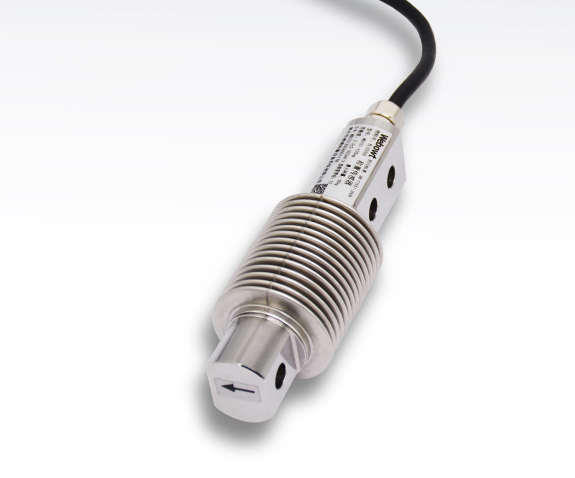
An aluminum load cell is a force sensor that uses an aluminum alloy spring element. Strain gauges are attached to this aluminum structure. When mechanical force is applied, the structure bends a little. The strain gauges then turn that bending into an electrical signal measured in mV/V.
Aluminum Load Cells offer clear practical benefits. The metal is lightweight, cost-effective, and has a good strength-to-weight ratio. It is also easy to machine, so manufacturers can make complex shapes at lower cost. These traits make aluminum load cells a common choice for many weighing tasks. Engineers and procurement specialists value this mix of properties.
Key Takeaways
Aluminum load cells are light, don't cost much, and work great for dry, indoor weighing jobs.
They work by turning force into electrical signals. They do this with strain gauges and a Wheatstone bridge.
Pick from S-type, single-point, or multi-point designs to fit your exact weighing needs.
For wet or harsh places, choose sealed or stainless steel models to make sure they last a long time.
Always match capacity, accuracy, and environment to prevent poor performance and early failure.
What Are Aluminum Load Cells and How Do They Work?
Definition and Basic Construction
An aluminum load cell is a force sensor built around a spring element made from aluminum alloy. Manufacturers machine this element from a solid block of metal. The most common alloys include 2024, 6061, and 7075. Each alloy offers a different balance of strength, elasticity, and machinability.
A sensing element (also called a "spring element" or "spring body") is a precisely machined piece of metal, typically high grade alloy steel, stainless steel, or aluminum. Only a few alloys can be used as there are stringent requirements for strength, linear elasticity, and corrosion resistance.
Aluminum is often picked for single-point load cells with low capacity. It is the most budget-friendly choice among common materials. Alloy 2023 stands out for its good low creep and hysteresis properties. The circuit usually has enameled wire or a PCB board with force-sensitive parts. Manufacturers put the circuit together by linking gauges across the sensing element.
From Force to Electrical Signal
A load cell uses a metal body (flexure) that foil strain gauges are glued to. When stress is applied, the bending that results creates strain the gauge picks up. The strain gauges are electrical conductors tightly stuck to a film in a zigzag shape. When the film is pulled, the conductors stretch out and get longer. When pushed, they shrink and get shorter. This shape change makes the resistance in the electrical conductors change. Resistance goes up with applied strain and goes down with contraction.
To measure these resistance changes, the gauges are wired into a Wheatstone bridge circuit. An excitation voltage is sent across the circuit. The output voltage is read across two points in the middle of the bridge. With no load, the bridge is balanced and output voltage is zero. Any small change in the material under the strain gauge leads to a change in output.
Feature | Strain Gauge | Load Cell |
What it is | Sensing element | Complete force transducer |
Output | Resistance change (ΔR) | mV/V, 4-20mA, digital (CAN, RS-485) |
Requires | External bridge, amplifier, mechanical structure | Only power and readout device |
Installation | Requires bonding to test surface | Bolt-on, ready to use |
Integrated structure | No | Yes (spring element) |
Temperature compensation | None or external | Built-in |
Calibration | Requires user calibration | Factory calibrated; traceable certificate available |
Because bridge output scales with excitation voltage, sensitivity is shown as output per volt of excitation at rated capacity. Common values are 1–3 mV/V, with 2 mV/V as the industry standard. For example, a 2 mV/V load cell excited at 5 V gives a full-scale differential output of just 10 mV. This signal is very small. A strain gauge amplifier or signal conditioner is usually needed to turn it into a higher-level analog or digital output for PLCs, DAQs, or displays.
Key Features and Advantages of Aluminum Load Cells
Lightweight and Cost-Effective Design
Aluminum is a big win when it comes to weight and cost. It weighs about one-third as much as steel. This low density makes it easier to handle and install. Aluminum also cuts fast, so makers can shape complex parts for less money. Stainless steel costs more and takes longer to machine. Aluminum Load Cells are great for tight budgets and still stay strong.
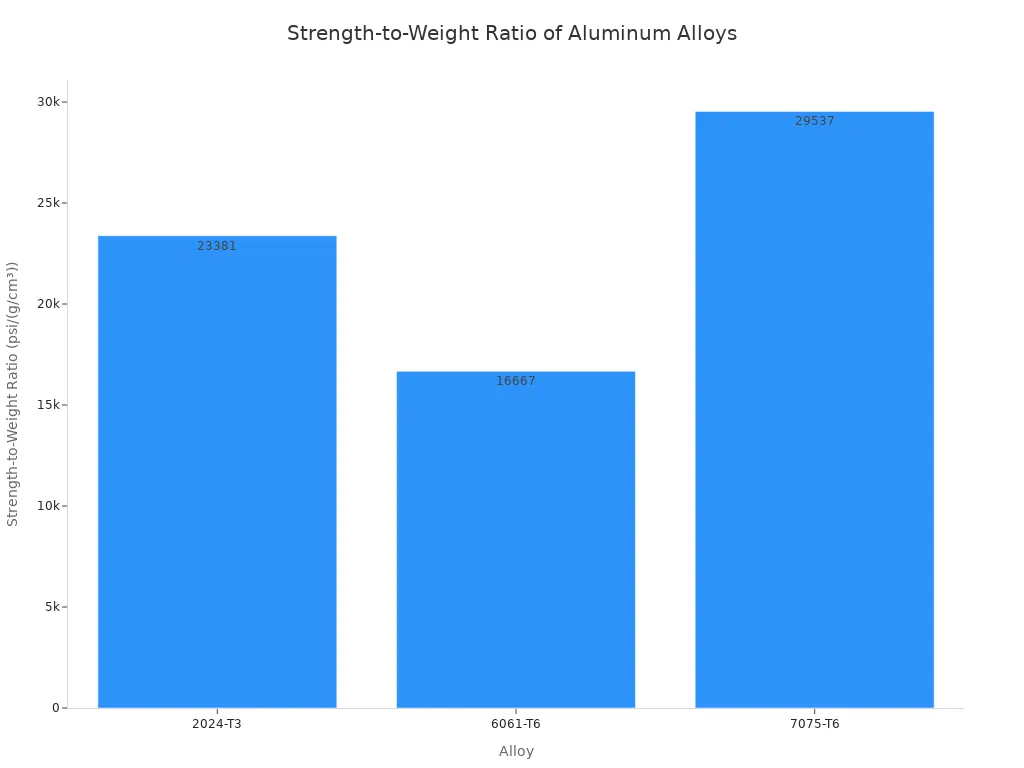
The strength-to-weight ratio changes with each alloy. Alloy 7075-T6 hits a tensile strength of 83,000 psi at a density of 2.81 g/cm³. Alloy 2024-T3 gives 65,000 psi at about 2.78 g/cm³. Alloy 6061-T6 offers 45,000 psi at roughly 2.70 g/cm³. The table below shows how these values compare.
Alloy | Tensile Strength (psi) | Density (g/cm³) | Strength-to-Weight Ratio (psi/(g/cm³)) |
2024-T3 | 65,000 | ~2.78 | ~23,381 |
6061-T6 | 45,000 | ~2.70 | ~16,667 |
7075-T6 | 83,000 | 2.81 | ~29,537 |
Performance Limits and Temperature Sensitivity
Aluminum load cells usually work for capacities up to about 1,000 kg. Past that point, stainless steel or alloy steel makes more sense. Aluminum also reacts more to temperature changes. The metal expands and shrinks more than steel. This shift throws off strain gauge readings. Makers add temperature compensation to fix this problem. A compensated cell stays accurate within a set temperature range.
These load cells do best indoors where there is little corrosion. Moisture, chemicals, and washdown conditions break down aluminum over time. In those cases, sealed stainless steel models protect better. Aluminum is still a good pick for dry, controlled spots like retail scales, bench scales, and lab balances.
Types of Aluminum Load Cells
An aluminum load cell is a force sensor that uses an aluminum alloy spring element. Strain gauges are attached to this aluminum structure. When mechanical force is applied, the structure bends a little. The strain gauges then turn that bending into an electrical signal measured in mV/V.
Aluminum Load Cells offer clear practical benefits. The metal is lightweight, cost-effective, and has a good strength-to-weight ratio. It is also easy to machine, so manufacturers can make complex shapes at lower cost. These traits make aluminum load cells a common choice for many weighing tasks. Engineers and procurement specialists value this mix of properties.
Key Takeaways
Aluminum load cells are light, don't cost much, and work great for dry, indoor weighing jobs.
They work by turning force into electrical signals. They do this with strain gauges and a Wheatstone bridge.
Pick from S-type, single-point, or multi-point designs to fit your exact weighing needs.
For wet or harsh places, choose sealed or stainless steel models to make sure they last a long time.
Always match capacity, accuracy, and environment to prevent poor performance and early failure.
What Are Aluminum Load Cells and How Do They Work?
Definition and Basic Construction
An aluminum load cell is a force sensor built around a spring element made from aluminum alloy. Manufacturers machine this element from a solid block of metal. The most common alloys include 2024, 6061, and 7075. Each alloy offers a different balance of strength, elasticity, and machinability.
A sensing element (also called a "spring element" or "spring body") is a precisely machined piece of metal, typically high grade alloy steel, stainless steel, or aluminum. Only a few alloys can be used as there are stringent requirements for strength, linear elasticity, and corrosion resistance.
Aluminum is often picked for single-point load cells with low capacity. It is the most budget-friendly choice among common materials. Alloy 2023 stands out for its good low creep and hysteresis properties. The circuit usually has enameled wire or a PCB board with force-sensitive parts. Manufacturers put the circuit together by linking gauges across the sensing element.
From Force to Electrical Signal
A load cell uses a metal body (flexure) that foil strain gauges are glued to. When stress is applied, the bending that results creates strain the gauge picks up. The strain gauges are electrical conductors tightly stuck to a film in a zigzag shape. When the film is pulled, the conductors stretch out and get longer. When pushed, they shrink and get shorter. This shape change makes the resistance in the electrical conductors change. Resistance goes up with applied strain and goes down with contraction.
To measure these resistance changes, the gauges are wired into a Wheatstone bridge circuit. An excitation voltage is sent across the circuit. The output voltage is read across two points in the middle of the bridge. With no load, the bridge is balanced and output voltage is zero. Any small change in the material under the strain gauge leads to a change in output.
Feature | Strain Gauge | Load Cell |
What it is | Sensing element | Complete force transducer |
Output | Resistance change (ΔR) | mV/V, 4-20mA, digital (CAN, RS-485) |
Requires | External bridge, amplifier, mechanical structure | Only power and readout device |
Installation | Requires bonding to test surface | Bolt-on, ready to use |
Integrated structure | No | Yes (spring element) |
Temperature compensation | None or external | Built-in |
Calibration | Requires user calibration | Factory calibrated; traceable certificate available |
Because bridge output scales with excitation voltage, sensitivity is shown as output per volt of excitation at rated capacity. Common values are 1–3 mV/V, with 2 mV/V as the industry standard. For example, a 2 mV/V load cell excited at 5 V gives a full-scale differential output of just 10 mV. This signal is very small. A strain gauge amplifier or signal conditioner is usually needed to turn it into a higher-level analog or digital output for PLCs, DAQs, or displays.
Key Features and Advantages of Aluminum Load Cells
Lightweight and Cost-Effective Design
Aluminum is a big win when it comes to weight and cost. It weighs about one-third as much as steel. This low density makes it easier to handle and install. Aluminum also cuts fast, so makers can shape complex parts for less money. Stainless steel costs more and takes longer to machine. Aluminum Load Cells are great for tight budgets and still stay strong.
The strength-to-weight ratio changes with each alloy. Alloy 7075-T6 hits a tensile strength of 83,000 psi at a density of 2.81 g/cm³. Alloy 2024-T3 gives 65,000 psi at about 2.78 g/cm³. Alloy 6061-T6 offers 45,000 psi at roughly 2.70 g/cm³. The table below shows how these values compare.
Alloy | Tensile Strength (psi) | Density (g/cm³) | Strength-to-Weight Ratio (psi/(g/cm³)) |
2024-T3 | 65,000 | ~2.78 | ~23,381 |
6061-T6 | 45,000 | ~2.70 | ~16,667 |
7075-T6 | 83,000 | 2.81 | ~29,537 |
Performance Limits and Temperature Sensitivity
Aluminum load cells usually work for capacities up to about 1,000 kg. Past that point, stainless steel or alloy steel makes more sense. Aluminum also reacts more to temperature changes. The metal expands and shrinks more than steel. This shift throws off strain gauge readings. Makers add temperature compensation to fix this problem. A compensated cell stays accurate within a set temperature range.
These load cells do best indoors where there is little corrosion. Moisture, chemicals, and washdown conditions break down aluminum over time. In those cases, sealed stainless steel models protect better. Aluminum is still a good pick for dry, controlled spots like retail scales, bench scales, and lab balances.
Types of Aluminum Load Cells
Aluminum load cells come in a few different designs. Each one works best for certain mounting needs and load directions. The three main types are S-type, single-point, and multi-point cells. Buyers should know how these types differ in shape and use.
S-Type Load Cells
An S-type load cell has a body shaped like the letter S. It has upper and lower mounting arms with a spring element in the center. Strain gauges are attached to this spring element. This design allows force to be measured in a straight line along the central axis. It can measure both pulling and pushing forces in two directions. The compact shape saves space. Threaded mounting points make it easy to install. Manufacturers sell these cells in aluminum and stainless steel. Stainless steel versions have hermetic sealing up to IP68.
S-type cells cover a wide range of capacities. Common capacities go from 2 kg to 20 tons. Accuracy stays within plus or minus 0.02% to 0.05% of full-scale output. They give excellent linearity. Heavy-duty stainless-steel S-Type transducers meet OIML 0.2 accuracy class for belt scale uses.
These cells give high-accuracy measurements at a lower price than many pancake-style cells. They work as universal sensors for pulling and pushing forces. Their slim shape fits tight spaces and goes easily into equipment, machines, and OEM products. Common uses include robotics, medical devices, drones, weighing, and lifting equipment. Other uses cover hanging scales, hopper scales, crane scales, tank weighing, and material strain testing.
Single-Point and Multi-Point Load Cells
Single-point and multi-point cells work for different weighing platform sizes. Their shapes and capacities set them apart.
Attribute | Single-Point Load Cell | Multi-Point (Platform) Load Cell |
Form Factor | Beam-shaped with two circular holes in the middle; mounting holes at both ends | Shear beam (solid rectangular profile) or flat platform type with multiple holes; matched sets of 4 available |
Capacity | Up to 50 kg | 500 kg and above |
Typical Use Cases | Small weighing scales such as kitchen scales and other small platform scales; supports off-axis loading | Durable multipoint weighing platforms for large dynamic loads, such as bathroom scales and livestock scales |
Single point load cells are widely used in commercial weighing systems, including supermarket scales, postal scales, and food packaging machinery. They use a single load-sensing element to provide consistent, accurate output even when the load is not perfectly centered.
Single-point cells are common in bench and retail scales. The market for these cells is growing. More demand for automated retail and healthcare solutions drives this growth. In retail, point-of-sale systems, self-checkout kiosks, and digital weighing scales fuel demand. These cells offer fast response, low maintenance, and easy digital integration. In healthcare, they show up in patient beds, infusion pumps, and laboratory balances. Low-capacity single-point cells range from a few grams to several kilograms. They serve retail scales, laboratory balances, and precision medical devices. The global single-point load cell market reached USD 1.27 billion in 2024. It is expected to reach USD 1.93 billion by 2033, with a CAGR of 4.8%.
Compression vs. Tension Aluminum Load Cells
The direction of force affects every choice about mounting hardware and how you install the cell. Compression cells hold weight that pushes down on the sensor body. Tension cells measure force that pulls away from the mounting points. This key difference decides how engineers place the cell, what hardware they pick, and which jobs make sense.
Compression Load Cells
A compression load cell sits under the load. The force pushes right into the cell body. Mounting hardware holds the cell in place from below. A base plate or mounting block supports the bottom surface. The load moves through a top plate or pressure piece. This setup keeps the cell steady under heavy static loads.
Alignment is very important here. The load must go straight through the cell's axis. Side forces or off-center loads cause errors and can harm the sensor. Engineers use guide rods, flexures, or self-aligning mounts to keep the force centered. Hopper scales, tank weighing systems, and platform scales depend on compression cells. These applications need ongoing measurement of heavy, still loads. The cell stays fixed while product weight presses down from above.
Tension Load Cells
A tension load cell hangs from its mounting points. The force pulls the cell body downward or outward. Threaded rods, shackles, or eyebolts link the cell to the structure. The load hangs below the sensor. This setup works well for hanging scales, crane scales, and suspended hoppers.
Mounting for tension cells needs secure attachment at both ends. The top connection anchors to a fixed beam or frame. The bottom connection holds the load. Any twisting or rotation adds error. Swivel joints or rod-end bearings help keep proper alignment. Hanging scales in retail and industrial settings use tension cells because the design naturally fits suspended loads. The cell measures the pull made by gravity acting on the weight below.
Both setups appear in aluminum load cells. The choice depends on whether the application pushes or pulls. Compression suits stationary platforms and vessels. Tension fits suspended weighing and dynamic lifting tasks.
Specialized Aluminum Load Cells
Low-Capacity Precision Models
Some aluminum load cells are made for jobs where the force being measured is very small. These low-capacity precision models work with ranges from a few grams up to about 10 kg. Medical devices depend on them a lot. A 500 g cell is used for ultra-precision micro-control tasks like infant infusion pumps. The 1 kg and 5 kg versions show up in syringe pumps, infusion monitoring devices, and precision drug delivery systems. Laboratory balances, materials testing machines, and precision measurement instruments often use 5 kg and 10 kg cells. These settings need high resolution and steady data output.
Accuracy is extremely important here. The FUTEK LRF400, for instance, keeps nonlinearity, hysteresis, and nonrepeatability within ±0.05% of rated output. When paired with a high-resolution signal conditioner at a 2.5 SPS sampling rate, a 0.25 lb capacity unit gets a resolution of 0.0000012 lb. Temperature compensation from 15 to 71°C keeps readings stable. The Interface ULC series covers 0.1 N to 5 N with ±0.05% full-scale nonlinearity and hysteresis. Its aluminum body weighs only 0.13 kg. These cells support robotics haptic feedback, medical device testing, and MEMS component testing. Strain gauge designs like these give low drift and long-term stability across a wide capacity range.
Corrosion-Resistant and Sealed Models
Aluminum works well indoors, but moisture and chemicals make it last a shorter time. For corrosive or washdown settings, stainless steel or sealed variants are often the better pick. Hard anodized aluminum gives moderate corrosion resistance for lightweight systems. Protective coatings and plating add more durability. Sealing methods for the strain gauge cavity include hermetic sealing, epoxy encapsulation, and glass-to-metal seals. Shielded cables with waterproof jackets and IP-rated connectors lower corrosion risk at connection points.
Ingress protection ratings help guide the choice. A minimum IP65 rating works for dusty or splashing environments. IP67 or IP68 is suggested for wet, outdoor, or washdown applications. The table below sums up the relevant IP digits.
IP Digit | Protection Against Solids | Protection Against Water |
5 | Dust-protection (limited ingress) | Water jets |
6 | Dust-tight (no ingress) | Powerful water jets |
7 | — | Temporary Immersion (< 30 min) |
8 | — | Continuous Immersion (depth specified) |
These sealed Aluminum Load Cells cost more than standard models. They pay back that cost through longer service life in demanding conditions.
Real-World Use Cases for Aluminum Load Cells
Industrial and Commercial Applications
Aluminum load cells show up in many industrial and commercial weighing jobs. Single-point cells work well in bench and platform scales because they handle off-center loads. Retail scales in grocery stores and specialty shops count on these cells for correct pricing. A 106B aluminum single-point load cell aims for 0.1% accuracy in small scale designs. Compression cells are used in truck scales and hopper weighing. Tension cells work in crane scales and overhead systems. Miniature cells help with robotics and aerospace testing.
Packaging, sorting, and batching operations rely on aluminum cells for speed and consistency. Loss-in-weight feeders use single-point and low-profile cells with high relative stiffness. These cells give stability for continuous feeding. A digital interface with configurable filtering removes vibration noise while keeping fast update rates. Liquid filling systems use fluid-damped and hermetically sealed cells with 150% to 400% overload protection. This design handles shock loads and wash-down. Tank and hopper batching uses compression cells up to 500 kg with custom mounting modules. Stainless steel construction and current calibration output make parallel connections simple for accurate total weight even with uneven loading.
Use Case | Aluminum Load Cell Role | Benefits |
Loss-in-weight feeders | Single-point and low-profile cells with high relative stiffness | Accurate material tracking, optimized feed rates, reduced waste |
Liquid filling systems | Fluid-damped, hermetically sealed cells with 150%–400% overload protection | Consistent fill volumes, reduced product loss, net-content compliance |
Tank & hopper batching | Compression cells up to 500 kg with custom mounting modules | Precise batching control, accurate inventory management |
Dynamic packaging | Models such as 1010/1015 (3–90 kg) and 1042 (C6 OIML, 1–200 kg) | Precise ingredient control, formulation compliance |
Medical and Laboratory Applications
Medical devices and laboratory balances need high precision and stable output. Aluminum load cells meet these needs in several important roles. Patient scales, pharmaceutical dispensing scales, and medical testing equipment all use these cells. They give high-speed, high-precision weighing with reliable measurement. Laboratory equipment and precision batching systems require tight creep performance. Aluminum cells reach creep of ±0.002% of rated output per 30 seconds and ±0.004% per 2 minutes. Nonlinearity stays within ±0.015% of rated output. Hysteresis and non-repeatability reach ±0.010% of rated output, which is better than typical C3-class performance of ±0.015% to ±0.020% under OIML R60.
Temperature-variable environments are no problem for compensated aluminum cells. Temperature effect on zero and sensitivity stays within ±0.02% of rated output per 10°C. Micro-capacity cells from 0.1 kg to 5 kg serve precision balances and jewelry scales with errors within ±1 g. Small-capacity cells from 5 kg to 30 kg power retail checkout scales and small packaging scales with resolution up to 1/30,000 and stabilization time of 0.5 seconds or less. High-capacity cells from 100 kg to 200 kg handle medical body scales and bench-type weighing with excellent off-center load tolerance. Portable medical transport scales benefit from the lightweight design, which lowers overall equipment weight.
Webowt High-Precision Load Cells & Weighing Modules
Webowt started in 2012 in Jiangsu Province, China. The company makes weighing indicators, load cells, scales, and smart weighing systems. It has OIML, CE, PAC, and EAC certifications, and its products go to more than 50 countries. This matters for buyers who need proof of compliance and a global supply.
Analog Load Cell Series and Models
The analog lineup covers a wide range of capacities. Each model is made for a different weighing job.
Model | Material | Capacity Range |
WB1020 | Aluminum | 300 g to 5 kg |
WB1260 | Aluminum | 50 g to 500 kg |
WB1260A | Aluminum | 10 g to 100 kg |
WB1260B | Aluminum | 3 g to 30 kg; 30 g to 250 kg; 15 kg to 75 kg |
WB1260BS | Stainless steel | 6 g to 300 kg |
WB701 | Bellows type | 10 g to 500 kg |
The WB1260B is a single-point cell with IP67 protection and an OIML R76 certificate. It works well for platform scales, bagging scales, counting scales, and process weighing equipment. Stainless steel versions use welded sealing to reach IP68, which keeps water and dust out during constant submersion. These models fit food processing, chemical plants, and outdoor hopper scales. Aluminum Load Cells are still the light, low-cost choice for dry indoor settings.
Digital Modules and Industrial Integration
Digital modules put a 24-bit ADC and a microprocessor inside the sensor. The unit changes analog voltage to digital data right at the source. It sends that data over CAN BUS at a 2–6 V communication voltage, which fights electrical noise much better than an analog signal. Sampling goes up to 1200 Hz, so the module handles dynamic weighing tasks like belt scales and sorting lines.
The internal processor makes up for temperature changes, nonlinearity, hysteresis, and voltage ups and downs. It also finds sensor faults, overloads, and network health for real-time monitoring. Digital calibration and plug-and-play corner adjustment make setup simple. Modbus RTU and TCP compatibility lets the modules connect to existing control systems without special cables.
How to Choose the Right Aluminum Load Cell
Matching Capacity, Accuracy, and Environment
Start by finding the heaviest weight you expect. A common mistake is picking a capacity that matches the maximum load exactly. Buyers must add the maximum live load (the weight being measured) and the dead load (the weight of the scale platform or tank). Then they add a safety buffer of 20-50% to protect the inner strain gauge from sudden shock loads. For example, a 1000 kg tank with a 200 kg hopper, multiplied by a 1.3 dynamic factor and a 1.5 safety factor, gives 2,340 kg. That means picking a 2,500 kg or 3,000 kg load cell. A capacity that is too small risks overload and serious failure. A capacity that is too large loses precision, especially in the lower measurement range.
Accuracy class comes next. OIML R60 defines classes like C3 (up to 3,000 verification intervals) and C6 (up to 6,000 intervals). Higher classes mean tighter error limits and better temperature performance.
Accuracy Class | Error Limit | Typical Applications | Cost Consideration |
C3 (Industry Standard) | ±0.02% FS | General industrial weighing, platform scales, tank weighing, process control | Moderate; best value for most applications |
C4 / C5 | ±0.015% – ±0.01% FS | High-precision batching, pharmaceutical, laboratory, legal-for-trade | 20–50% premium over C3 |
For a 1000 kg scale, a C3 load cell (±0.02%) has a potential error of ±0.2 kg. For most industrial applications, this is perfectly acceptable. However, for pharmaceutical dosing requiring milligram precision, a C5 cell is necessary—and the price reflects that capability.
Environment plays a big role. Temperature changes make materials expand and shrink. A 10°C rise in room temperature without compensation could cause output drift up to ±0.05% of full scale. Moisture damages strain gauges and rusts internal parts. Ingress protection ratings guide the choice:
IP65/IP66: Protected against dust and water jets. Suitable for most indoor industrial environments. Adds 10–20% to base cost.
IP67: Temporary immersion (up to 1m for 30 minutes). Common in food processing and outdoor installations. Moderate cost premium.
IP68/IP69K: Continuous immersion and high-pressure washdown. Requires hermetic sealing (glass-to-metal feedthroughs, welded enclosures). Significant cost premium—often 30–50% higher than non-sealed equivalents.
In wet or corrosive environments, skimping on IP rating is false economy. Moisture ingress is a leading cause of load cell failure, and replacing a failed cell often costs far more than the initial price difference.
Integration and Cost Considerations
Working with your current equipment matters as much as the cell itself. A 4–20 mA output load cell connected to an indicator expecting mV/V will produce no reading or a completely incorrect one. Buyers must check that the load cell output matches their indicator input before purchase. Output types differ in cable length limits and noise immunity. The mV/V analog signal works up to 50 m with low noise immunity. The 4–20 mA current output reaches up to 300 m or more with high noise immunity. RS-485 and Modbus handle up to 1,200 m with very high noise immunity. Fieldbus and Ethernet options support smart factories and real-time control.
Total cost of ownership goes beyond purchase price. Purchase price accounts for 15–30% of total cost. Installation adds 10–20%. Calibration adds 15–25%. Maintenance adds 10–15%. Downtime costs from failures or replacements add 20–40%. Replacement parts add 5–15%. A cheap cell that fails often costs more over time than a reliable one.
Webowt's drop-in replacement design cuts downtime. The plug-and-play corner adjustment makes calibration simple. These features lower installation and maintenance costs. For buyers comparing Aluminum Load Cells, these integration details often decide the final choice.
Aluminum Load Cells use a spring element made of aluminum alloy with strain gauges attached. They are lightweight, low in cost, and have a good strength-to-weight ratio. Common types include S-type, single-point, and multi-point designs. These cells work in bench scales, retail scales, packaging lines, medical devices, and laboratory balances.
Picking the right cell takes careful thought. Capacity, environment, accuracy class, and cost all matter. A cell that does not match leads to poor performance or early failure. Readers can use this guide as a helpful reference. For custom solutions, ask manufacturers like Webowt. Their team helps match the right load cell to each application.
FAQ
When should someone choose aluminum over stainless steel?
Aluminum is best for dry, indoor places where there is little chance of rust. It costs less and weighs about one-third as much as steel. Stainless steel works well in washdown, chemical, and outdoor settings. Sealed stainless models can reach IP68 protection for being underwater for a long time.
What capacity range do aluminum load cells cover?
Most aluminum load cells can handle weights up to about 1,000 kg. Alloy 2024, 6061, and 7075 meet different strength needs. Alloy 7075-T6 has a tensile strength of 83,000 psi. Above 1,000 kg, stainless steel or alloy steel is the better pick.
Why do aluminum load cells need temperature compensation?
Aluminum gets bigger and smaller more than steel when the temperature changes. This movement shifts strain gauge readings and causes output drift. Manufacturers add temperature compensation to fix this issue. A compensated cell stays accurate within a set temperature range.
What is the difference between single-point and S-type load cells?
Single-point cells handle off-center loads on small platforms. They show up in bench scales, retail scales, and laboratory balances. S-type cells measure both pulling and pushing forces along one axis. They work in hanging scales, hopper scales, and crane systems.
Which environments require sealed or corrosion-resistant models?
Moisture, chemicals, and washdown conditions break down standard aluminum over time. A minimum IP65 rating works for dusty or splashing areas. IP67 or IP68 suits wet, outdoor, or washdown uses. Hard anodized aluminum gives moderate corrosion resistance for lightweight systems.
Aluminum load cells come in a few different designs. Each one works best for certain mounting needs and load directions. The three main types are S-type, single-point, and multi-point cells. Buyers should know how these types differ in shape and use.
S-Type Load Cells
An S-type load cell has a body shaped like the letter S. It has upper and lower mounting arms with a spring element in the center. Strain gauges are attached to this spring element. This design allows force to be measured in a straight line along the central axis. It can measure both pulling and pushing forces in two directions. The compact shape saves space. Threaded mounting points make it easy to install. Manufacturers sell these cells in aluminum and stainless steel. Stainless steel versions have hermetic sealing up to IP68.
S-type cells cover a wide range of capacities. Common capacities go from 2 kg to 20 tons. Accuracy stays within plus or minus 0.02% to 0.05% of full-scale output. They give excellent linearity. Heavy-duty stainless-steel S-Type transducers meet OIML 0.2 accuracy class for belt scale uses.
These cells give high-accuracy measurements at a lower price than many pancake-style cells. They work as universal sensors for pulling and pushing forces. Their slim shape fits tight spaces and goes easily into equipment, machines, and OEM products. Common uses include robotics, medical devices, drones, weighing, and lifting equipment. Other uses cover hanging scales, hopper scales, crane scales, tank weighing, and material strain testing.
Single-Point and Multi-Point Load Cells
Single-point and multi-point cells work for different weighing platform sizes. Their shapes and capacities set them apart.
Attribute | Single-Point Load Cell | Multi-Point (Platform) Load Cell |
Form Factor | Beam-shaped with two circular holes in the middle; mounting holes at both ends | Shear beam (solid rectangular profile) or flat platform type with multiple holes; matched sets of 4 available |
Capacity | Up to 50 kg | 500 kg and above |
Typical Use Cases | Small weighing scales such as kitchen scales and other small platform scales; supports off-axis loading | Durable multipoint weighing platforms for large dynamic loads, such as bathroom scales and livestock scales |
Single point load cells are widely used in commercial weighing systems, including supermarket scales, postal scales, and food packaging machinery. They use a single load-sensing element to provide consistent, accurate output even when the load is not perfectly centered.
Single-point cells are common in bench and retail scales. The market for these cells is growing. More demand for automated retail and healthcare solutions drives this growth. In retail, point-of-sale systems, self-checkout kiosks, and digital weighing scales fuel demand. These cells offer fast response, low maintenance, and easy digital integration. In healthcare, they show up in patient beds, infusion pumps, and laboratory balances. Low-capacity single-point cells range from a few grams to several kilograms. They serve retail scales, laboratory balances, and precision medical devices. The global single-point load cell market reached USD 1.27 billion in 2024. It is expected to reach USD 1.93 billion by 2033, with a CAGR of 4.8%.
Compression vs. Tension Aluminum Load Cells
The direction of force affects every choice about mounting hardware and how you install the cell. Compression cells hold weight that pushes down on the sensor body. Tension cells measure force that pulls away from the mounting points. This key difference decides how engineers place the cell, what hardware they pick, and which jobs make sense.
Compression Load Cells
A compression load cell sits under the load. The force pushes right into the cell body. Mounting hardware holds the cell in place from below. A base plate or mounting block supports the bottom surface. The load moves through a top plate or pressure piece. This setup keeps the cell steady under heavy static loads.
Alignment is very important here. The load must go straight through the cell's axis. Side forces or off-center loads cause errors and can harm the sensor. Engineers use guide rods, flexures, or self-aligning mounts to keep the force centered. Hopper scales, tank weighing systems, and platform scales depend on compression cells. These applications need ongoing measurement of heavy, still loads. The cell stays fixed while product weight presses down from above.
Tension Load Cells
A tension load cell hangs from its mounting points. The force pulls the cell body downward or outward. Threaded rods, shackles, or eyebolts link the cell to the structure. The load hangs below the sensor. This setup works well for hanging scales, crane scales, and suspended hoppers.
Mounting for tension cells needs secure attachment at both ends. The top connection anchors to a fixed beam or frame. The bottom connection holds the load. Any twisting or rotation adds error. Swivel joints or rod-end bearings help keep proper alignment. Hanging scales in retail and industrial settings use tension cells because the design naturally fits suspended loads. The cell measures the pull made by gravity acting on the weight below.
Both setups appear in aluminum load cells. The choice depends on whether the application pushes or pulls. Compression suits stationary platforms and vessels. Tension fits suspended weighing and dynamic lifting tasks.
Specialized Aluminum Load Cells
Low-Capacity Precision Models
Some aluminum load cells are made for jobs where the force being measured is very small. These low-capacity precision models work with ranges from a few grams up to about 10 kg. Medical devices depend on them a lot. A 500 g cell is used for ultra-precision micro-control tasks like infant infusion pumps. The 1 kg and 5 kg versions show up in syringe pumps, infusion monitoring devices, and precision drug delivery systems. Laboratory balances, materials testing machines, and precision measurement instruments often use 5 kg and 10 kg cells. These settings need high resolution and steady data output.
Accuracy is extremely important here. The FUTEK LRF400, for instance, keeps nonlinearity, hysteresis, and nonrepeatability within ±0.05% of rated output. When paired with a high-resolution signal conditioner at a 2.5 SPS sampling rate, a 0.25 lb capacity unit gets a resolution of 0.0000012 lb. Temperature compensation from 15 to 71°C keeps readings stable. The Interface ULC series covers 0.1 N to 5 N with ±0.05% full-scale nonlinearity and hysteresis. Its aluminum body weighs only 0.13 kg. These cells support robotics haptic feedback, medical device testing, and MEMS component testing. Strain gauge designs like these give low drift and long-term stability across a wide capacity range.
Corrosion-Resistant and Sealed Models
Aluminum works well indoors, but moisture and chemicals make it last a shorter time. For corrosive or washdown settings, stainless steel or sealed variants are often the better pick. Hard anodized aluminum gives moderate corrosion resistance for lightweight systems. Protective coatings and plating add more durability. Sealing methods for the strain gauge cavity include hermetic sealing, epoxy encapsulation, and glass-to-metal seals. Shielded cables with waterproof jackets and IP-rated connectors lower corrosion risk at connection points.
Ingress protection ratings help guide the choice. A minimum IP65 rating works for dusty or splashing environments. IP67 or IP68 is suggested for wet, outdoor, or washdown applications. The table below sums up the relevant IP digits.
IP Digit | Protection Against Solids | Protection Against Water |
5 | Dust-protection (limited ingress) | Water jets |
6 | Dust-tight (no ingress) | Powerful water jets |
7 | — | Temporary Immersion (< 30 min) |
8 | — | Continuous Immersion (depth specified) |
These sealed Aluminum Load Cells cost more than standard models. They pay back that cost through longer service life in demanding conditions.
Real-World Use Cases for Aluminum Load Cells
Industrial and Commercial Applications
Aluminum load cells show up in many industrial and commercial weighing jobs. Single-point cells work well in bench and platform scales because they handle off-center loads. Retail scales in grocery stores and specialty shops count on these cells for correct pricing. A 106B aluminum single-point load cell aims for 0.1% accuracy in small scale designs. Compression cells are used in truck scales and hopper weighing. Tension cells work in crane scales and overhead systems. Miniature cells help with robotics and aerospace testing.
Packaging, sorting, and batching operations rely on aluminum cells for speed and consistency. Loss-in-weight feeders use single-point and low-profile cells with high relative stiffness. These cells give stability for continuous feeding. A digital interface with configurable filtering removes vibration noise while keeping fast update rates. Liquid filling systems use fluid-damped and hermetically sealed cells with 150% to 400% overload protection. This design handles shock loads and wash-down. Tank and hopper batching uses compression cells up to 500 kg with custom mounting modules. Stainless steel construction and current calibration output make parallel connections simple for accurate total weight even with uneven loading.
Use Case | Aluminum Load Cell Role | Benefits |
Loss-in-weight feeders | Single-point and low-profile cells with high relative stiffness | Accurate material tracking, optimized feed rates, reduced waste |
Liquid filling systems | Fluid-damped, hermetically sealed cells with 150%–400% overload protection | Consistent fill volumes, reduced product loss, net-content compliance |
Tank & hopper batching | Compression cells up to 500 kg with custom mounting modules | Precise batching control, accurate inventory management |
Dynamic packaging | Models such as 1010/1015 (3–90 kg) and 1042 (C6 OIML, 1–200 kg) | Precise ingredient control, formulation compliance |
Medical and Laboratory Applications
Medical devices and laboratory balances need high precision and stable output. Aluminum load cells meet these needs in several important roles. Patient scales, pharmaceutical dispensing scales, and medical testing equipment all use these cells. They give high-speed, high-precision weighing with reliable measurement. Laboratory equipment and precision batching systems require tight creep performance. Aluminum cells reach creep of ±0.002% of rated output per 30 seconds and ±0.004% per 2 minutes. Nonlinearity stays within ±0.015% of rated output. Hysteresis and non-repeatability reach ±0.010% of rated output, which is better than typical C3-class performance of ±0.015% to ±0.020% under OIML R60.
Temperature-variable environments are no problem for compensated aluminum cells. Temperature effect on zero and sensitivity stays within ±0.02% of rated output per 10°C. Micro-capacity cells from 0.1 kg to 5 kg serve precision balances and jewelry scales with errors within ±1 g. Small-capacity cells from 5 kg to 30 kg power retail checkout scales and small packaging scales with resolution up to 1/30,000 and stabilization time of 0.5 seconds or less. High-capacity cells from 100 kg to 200 kg handle medical body scales and bench-type weighing with excellent off-center load tolerance. Portable medical transport scales benefit from the lightweight design, which lowers overall equipment weight.
Webowt High-Precision Load Cells & Weighing Modules
Webowt started in 2012 in Jiangsu Province, China. The company makes weighing indicators, load cells, scales, and smart weighing systems. It has OIML, CE, PAC, and EAC certifications, and its products go to more than 50 countries. This matters for buyers who need proof of compliance and a global supply.
Analog Load Cell Series and Models
The analog lineup covers a wide range of capacities. Each model is made for a different weighing job.
Model | Material | Capacity Range |
WB1020 | Aluminum | 300 g to 5 kg |
WB1260 | Aluminum | 50 g to 500 kg |
WB1260A | Aluminum | 10 g to 100 kg |
WB1260B | Aluminum | 3 g to 30 kg; 30 g to 250 kg; 15 kg to 75 kg |
WB1260BS | Stainless steel | 6 g to 300 kg |
WB701 | Bellows type | 10 g to 500 kg |
The WB1260B is a single-point cell with IP67 protection and an OIML R76 certificate. It works well for platform scales, bagging scales, counting scales, and process weighing equipment. Stainless steel versions use welded sealing to reach IP68, which keeps water and dust out during constant submersion. These models fit food processing, chemical plants, and outdoor hopper scales. Aluminum Load Cells are still the light, low-cost choice for dry indoor settings.
Digital Modules and Industrial Integration
Digital modules put a 24-bit ADC and a microprocessor inside the sensor. The unit changes analog voltage to digital data right at the source. It sends that data over CAN BUS at a 2–6 V communication voltage, which fights electrical noise much better than an analog signal. Sampling goes up to 1200 Hz, so the module handles dynamic weighing tasks like belt scales and sorting lines.
The internal processor makes up for temperature changes, nonlinearity, hysteresis, and voltage ups and downs. It also finds sensor faults, overloads, and network health for real-time monitoring. Digital calibration and plug-and-play corner adjustment make setup simple. Modbus RTU and TCP compatibility lets the modules connect to existing control systems without special cables.
How to Choose the Right Aluminum Load Cell
Matching Capacity, Accuracy, and Environment
Start by finding the heaviest weight you expect. A common mistake is picking a capacity that matches the maximum load exactly. Buyers must add the maximum live load (the weight being measured) and the dead load (the weight of the scale platform or tank). Then they add a safety buffer of 20-50% to protect the inner strain gauge from sudden shock loads. For example, a 1000 kg tank with a 200 kg hopper, multiplied by a 1.3 dynamic factor and a 1.5 safety factor, gives 2,340 kg. That means picking a 2,500 kg or 3,000 kg load cell. A capacity that is too small risks overload and serious failure. A capacity that is too large loses precision, especially in the lower measurement range.
Accuracy class comes next. OIML R60 defines classes like C3 (up to 3,000 verification intervals) and C6 (up to 6,000 intervals). Higher classes mean tighter error limits and better temperature performance.
Accuracy Class | Error Limit | Typical Applications | Cost Consideration |
C3 (Industry Standard) | ±0.02% FS | General industrial weighing, platform scales, tank weighing, process control | Moderate; best value for most applications |
C4 / C5 | ±0.015% – ±0.01% FS | High-precision batching, pharmaceutical, laboratory, legal-for-trade | 20–50% premium over C3 |
For a 1000 kg scale, a C3 load cell (±0.02%) has a potential error of ±0.2 kg. For most industrial applications, this is perfectly acceptable. However, for pharmaceutical dosing requiring milligram precision, a C5 cell is necessary—and the price reflects that capability.
Environment plays a big role. Temperature changes make materials expand and shrink. A 10°C rise in room temperature without compensation could cause output drift up to ±0.05% of full scale. Moisture damages strain gauges and rusts internal parts. Ingress protection ratings guide the choice:
IP65/IP66: Protected against dust and water jets. Suitable for most indoor industrial environments. Adds 10–20% to base cost.
IP67: Temporary immersion (up to 1m for 30 minutes). Common in food processing and outdoor installations. Moderate cost premium.
IP68/IP69K: Continuous immersion and high-pressure washdown. Requires hermetic sealing (glass-to-metal feedthroughs, welded enclosures). Significant cost premium—often 30–50% higher than non-sealed equivalents.
In wet or corrosive environments, skimping on IP rating is false economy. Moisture ingress is a leading cause of load cell failure, and replacing a failed cell often costs far more than the initial price difference.
Integration and Cost Considerations
Working with your current equipment matters as much as the cell itself. A 4–20 mA output load cell connected to an indicator expecting mV/V will produce no reading or a completely incorrect one. Buyers must check that the load cell output matches their indicator input before purchase. Output types differ in cable length limits and noise immunity. The mV/V analog signal works up to 50 m with low noise immunity. The 4–20 mA current output reaches up to 300 m or more with high noise immunity. RS-485 and Modbus handle up to 1,200 m with very high noise immunity. Fieldbus and Ethernet options support smart factories and real-time control.
Total cost of ownership goes beyond purchase price. Purchase price accounts for 15–30% of total cost. Installation adds 10–20%. Calibration adds 15–25%. Maintenance adds 10–15%. Downtime costs from failures or replacements add 20–40%. Replacement parts add 5–15%. A cheap cell that fails often costs more over time than a reliable one.
Webowt's drop-in replacement design cuts downtime. The plug-and-play corner adjustment makes calibration simple. These features lower installation and maintenance costs. For buyers comparing Aluminum Load Cells, these integration details often decide the final choice.
Aluminum Load Cells use a spring element made of aluminum alloy with strain gauges attached. They are lightweight, low in cost, and have a good strength-to-weight ratio. Common types include S-type, single-point, and multi-point designs. These cells work in bench scales, retail scales, packaging lines, medical devices, and laboratory balances.
Picking the right cell takes careful thought. Capacity, environment, accuracy class, and cost all matter. A cell that does not match leads to poor performance or early failure. Readers can use this guide as a helpful reference. For custom solutions, ask manufacturers like Webowt. Their team helps match the right load cell to each application.
FAQ
When should someone choose aluminum over stainless steel?
Aluminum is best for dry, indoor places where there is little chance of rust. It costs less and weighs about one-third as much as steel. Stainless steel works well in washdown, chemical, and outdoor settings. Sealed stainless models can reach IP68 protection for being underwater for a long time.
What capacity range do aluminum load cells cover?
Most aluminum load cells can handle weights up to about 1,000 kg. Alloy 2024, 6061, and 7075 meet different strength needs. Alloy 7075-T6 has a tensile strength of 83,000 psi. Above 1,000 kg, stainless steel or alloy steel is the better pick.
Why do aluminum load cells need temperature compensation?
Aluminum gets bigger and smaller more than steel when the temperature changes. This movement shifts strain gauge readings and causes output drift. Manufacturers add temperature compensation to fix this issue. A compensated cell stays accurate within a set temperature range.
What is the difference between single-point and S-type load cells?
Single-point cells handle off-center loads on small platforms. They show up in bench scales, retail scales, and laboratory balances. S-type cells measure both pulling and pushing forces along one axis. They work in hanging scales, hopper scales, and crane systems.
Which environments require sealed or corrosion-resistant models?
Moisture, chemicals, and washdown conditions break down standard aluminum over time. A minimum IP65 rating works for dusty or splashing areas. IP67 or IP68 suits wet, outdoor, or washdown uses. Hard anodized aluminum gives moderate corrosion resistance for lightweight systems.